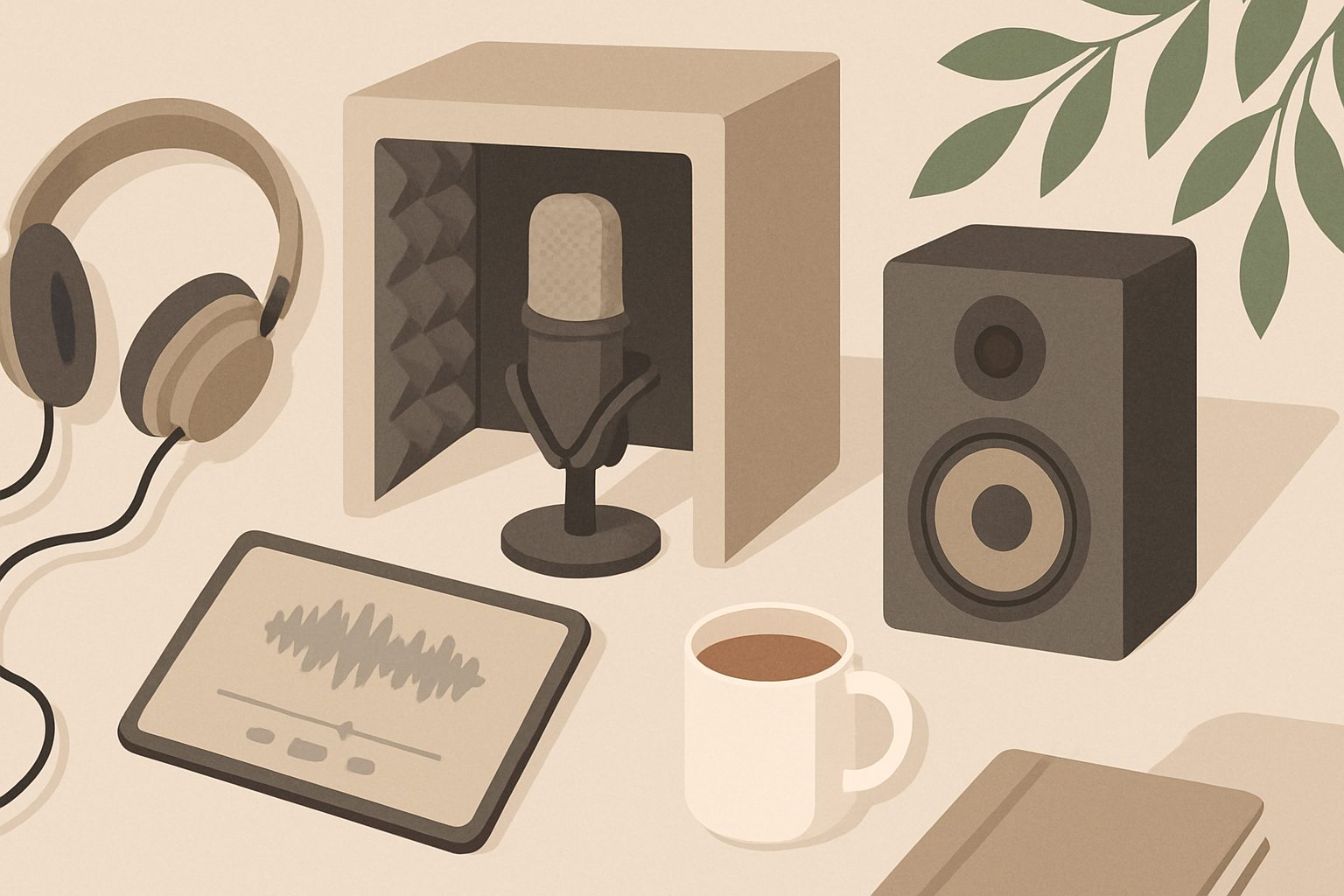
Best Acoustic Booths for Voice-Over Artists Working from Home UK
Working as a voice-over artist from home comes with one unavoidable problem: sound. Road noise, heating hum, appliances, neighbours—they're all waiting to ruin a take. A vocal booth solves this by isolating your recording space, letting you capture clean audio without expensive studio time or expensive acoustic treatment across an entire room.
But not all booths are created equal. Professional voice-over work has specific demands: you need isolation tight enough to kill background rumble, acoustic treatment that doesn't colour your voice unnaturally, and ideally something that doesn't eat your entire home office.
What Makes a Good Vocal Booth for VO Work?
A proper vocal booth combines three things: isolation, absorption, and reflection control. Isolation stops external noise getting in (and protects others from hearing your takes). Absorption kills reverb so your voice sounds dry and close. Reflection management prevents the "boxy" resonance that cheap booths suffer from.
For voice-over specifically, you're recording dialogue, narration, or character work at fairly close mic distance—usually 4–6 inches. This means the booth doesn't need to be large, but it does need to handle the proximity effect well. Poor internal treatment makes your voice sound thin and hollow up close, or boomy and distant. Professional booths use layered foam and careful internal geometry to avoid this.
The other critical spec is noise floor. If your home has typical urban noise—traffic, neighbours, boilers—you need a booth that genuinely attenuates low frequencies. Thin foam alone won't do it; you need mass and air gaps.
Portable vs Permanent: Which Suits Your Setup?
This splits into two camps. Portable booths (usually foldable or collapsible) cost £200–£800 and work in any room. They're quick to set up, don't require installation, and you can move them if you change workspace. The trade-off: smaller internal space means a naturally confined sound, which some voice actors like but others find claustrophobic. They also offer more modest isolation—typically 10–15 dB attenuation of mid/high frequencies, less for low-end rumble.
Permanent installations—whether a DIY frame-and-foam build or a bespoke prefab booth—cost £1,500–£5,000+ but deliver noticeably better isolation and acoustic control. They're larger, more comfortable for longer sessions, and easier to tweak internally.
For freelance VO artists, portable makes sense if you move regularly or want to test the waters before committing budget. If you're recording 20+ hours a week from the same desk, a proper booth pays for itself quickly in reduced noise issues and cleaner takes.
Key Features for Professional Voice-Over Recording
Noise attenuation: Look for booths specifying isolation in decibels, ideally across frequency ranges. A good portable booth hits 15–20 dB in the 500 Hz–4 kHz range (where voice lives). Permanent booths should exceed 25 dB.
Internal geometry: Avoid perfect cube interiors—they create modal resonance and standing waves. Angled walls, wedge foam, and asymmetrical designs distribute reflections better. This matters far more than raw foam thickness.
Microphone mounting: A decent boom arm lets you position the mic precisely and keeps handling noise off the capsule. Some booths include this; many don't. Budget another £40–£80 if needed.
Acoustic door seals: Cheap booths have drafty seals that leak noise at the frame. Listen to demo recordings carefully—if you hear muffled traffic, the seal is leaking.
Collapsibility: If portability matters, check collapse dimensions and weight. Some "portable" booths are genuinely awkward to move regularly.
Cable routing: Voice-over setups often run USB and XLR out of the booth. Look for booths with routed cable management so you're not squeezing wires through gaps.
Space and Installation Considerations
A typical portable vocal booth needs floor space equivalent to a shower cubicle (roughly 0.75–1 m² in footprint). Permanent booths range from 1.5 m² upwards. Before buying, measure your room and account for microphone distance, boom arm reach, and enough space to sit comfortably.
Ventilation matters more than you'd think. A sealed booth in a warm room quickly becomes uncomfortable. Better booths have ventilation ducts or damped air gaps that let heat out without letting sound in. Without this, you're limited to 1–2 hour sessions.
If you're renting, portability isn't optional. If you own or have landlord agreement, a semi-permanent frame lets you use proper acoustic panels and bass traps, which is overkill for most freelancers but gives studio-grade isolation if you're running a serious operation.
Budget Tiers and What You Actually Get
Under £400: Basic pop-filter foam booths or small portable boxes. Expect 10–12 dB isolation, obvious internal resonance, and discomfort after 45 minutes.
£400–£800: Decent portable booths with proper internal treatment, better seals, and 15–18 dB isolation. Brands here generally know what they're doing; isolation is real and usable for voice-over work.
£800–£1,500: Premium portables or budget permanent frame builds. You're getting noticeable improvement in isolation and acoustic accuracy. Worth considering if you record daily.
£1,500+: Purpose-built isolation booths with professional-grade seals, ventilation, internal acoustic treatment, and 25+ dB isolation. If you're earning serious VO income, the tax efficiency and time saved justify the cost.
The Honest Take
A £600 portable booth isn't a replacement for a £3,000 isolation booth. But it is a vast improvement over recording in an untreated room. If your home is reasonably quiet and you can treat external noise separately (recording late, closing windows), a mid-range portable booth works fine. If you're in central London surrounded by traffic and neighbours, the isolation gap matters—you'll spend time on retakes instead of isolation if you cheap out.
Most professional voice-over artists working from home land somewhere in the £600–£1,200 range: a quality portable or compact frame build that balances isolation, comfort, and budget reality.
More options
- Portable Vocal Isolation Tents & Pop-Up Recording Booths (Amazon UK)
- Microphone Reflection Filters & Desktop Isolation Shields (Amazon UK)
- Acoustic Foam Panels & Bass Traps for Home Studios (Amazon UK)
- Freestanding Acoustic Office Pods & Soundproof Cabins (Amazon UK)
- Mass Loaded Vinyl & Soundproofing Barriers (Amazon UK)